Have you ever stood in the cleaning aisle holding two bottles that look almost alike and had no idea how to choose? I do it too, and I read labels for a living. The front of the bottle is doing the least useful work in the store. The line that matters is the small print on the back.
I am Lauren, and I own Green Gorilla. This is the short list I hand people when they ask which fragrance-free products actually work, and where I stop trying to make something at home.
Read the back of the bottle, not the front
Muted colors. Kraft paper. A leaf. Words like natural, clean, eco-friendly, and plant-based. None of it tells me what is inside. I have watched brands dress up a bottle to look greener while the ingredient list barely moved.
So I skip the front. I flip the bottle and look for one word: fragrance. When a label says fragrance or parfum and nothing more, I have no way to find out what is behind it. That one word is why my own approach starts with scent-free.
I went further into the why in my non-toxic cleaning guide, and into how the labeling works in what is really in conventional cleaners.
The swaps I actually use, job by job
People expect a long list here. It is short.
Glass and mirrors
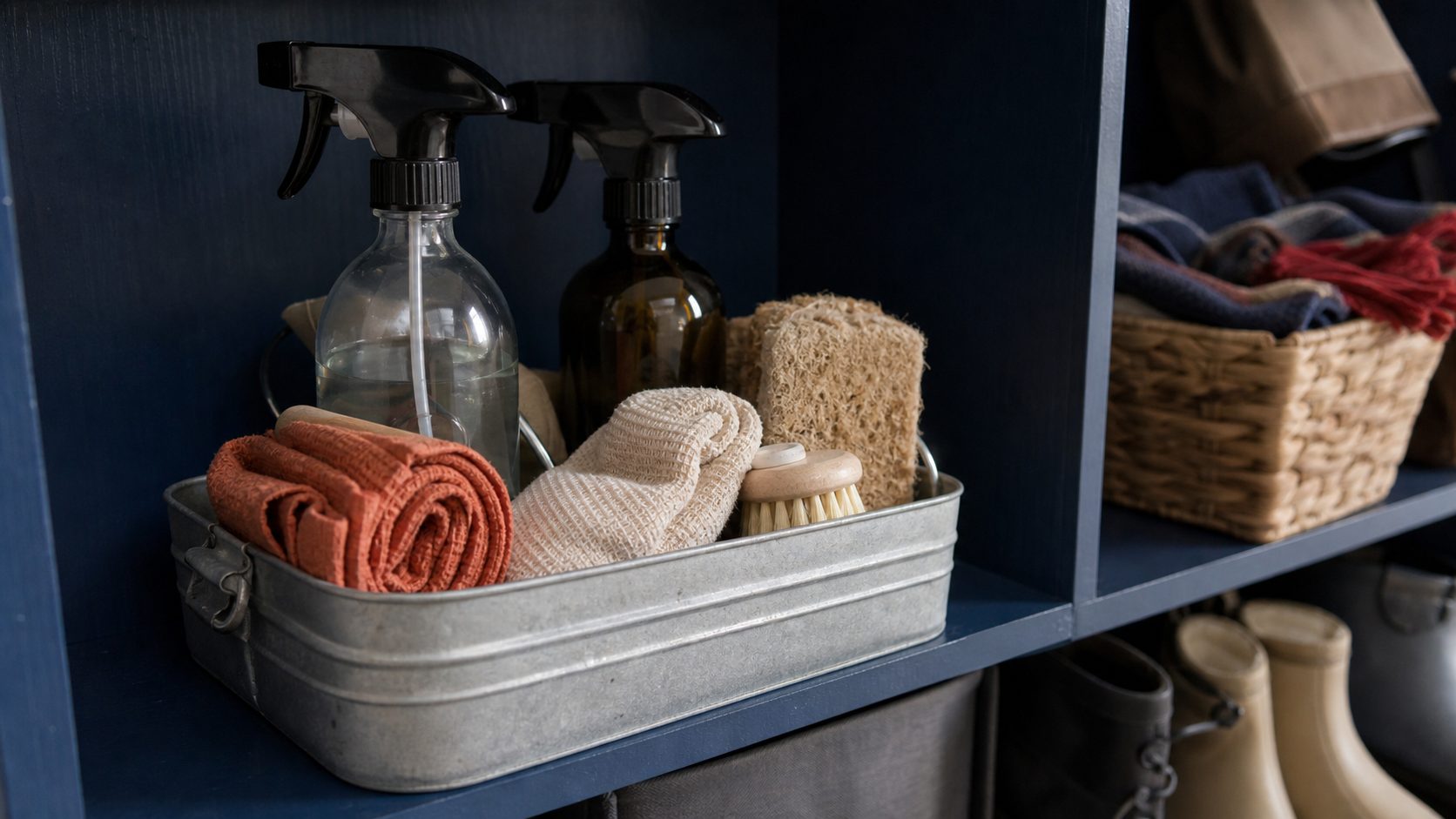
Equal parts white vinegar and water in a spray bottle, wiped with a microfiber cloth. That handles fingerprints, dust, and hard water spots on glass. Keep it off natural stone, since the acid dulls marble, travertine, and granite over time. The vinegar smell fades as it dries.
Counters and everyday surfaces
A few drops of castile soap in a spray bottle of warm water does most of it. For heavier grime I dilute Dr. Bronner's Sal Suds. I will be honest about that one. Sal Suds is not fragrance-free. Its scent comes from fir and spruce oils, and that is a trade I decided I was fine with. If you want zero scent, plain soap and water is your answer.
Sinks, tubs, and shower walls
Baking soda, a damp cloth, and some patience. It lifts soap scum and stuck-on gunk without scratching the finish, and it leaves nothing hanging in the air in a small bathroom with the door shut.
Floors
A capful of Sal Suds in a bucket of warm water. Wring the mop out hard. Less water is better on almost every floor, and standing water is how a floor gets ruined.
Dishes
ECOS Free & Clear stays by my sink. It is the scent-free one in that line, and it handles grease.
Cooked-on stove messes
This is where I stop pretending the homemade version wins. Mrs. Meyer's Baking Soda Cream Cleaner outperforms anything I have mixed myself on a stovetop. It is scented, lemon verbena, and I would rather say that plainly than call it fragrance-free. I use it there, I run the vent, and I move on.
Why I am writing about this right now
New research out of Purdue University picked up a lot of attention this fall, and it is the clearest explanation I have come across for why a scent-free home is worth the trouble.
Nusrat Jung and Brandon Boor run their experiments in a lab on the Purdue campus built to work like a real house. They found that the fragrance compounds in scented products, a group called terpenes, react with the ozone that drifts indoors through ventilation. That reaction makes new particles in the air, and the team is measuring them at the single nanometer scale. The ones under three nanometers have their own name now, nanocluster aerosol.
Here is the number that stopped me. From a single exposure to scented products, somewhere between 100 billion and 10 trillion of those particles can deposit in your respiratory system within about 20 minutes. Counted by particle number, scented products match or beat gas stoves and car engines at producing them. And scented wax melts, which get sold as the flame-free, nontoxic choice, pollute indoor air at least as much as candles do.
Their findings are peer reviewed and published in journals including Environmental Science & Technology Letters and ACS ES&T Air. The summary I read is here: Purdue University researchers on indoor nanoparticle formation.
I am not going to tell you this causes disease. The researchers did not say that, and the long term picture is still open. What they wrote is that these processes should be factored into how buildings and their HVAC systems run, and that heavily scented products need more study. My takeaway is narrower than a health claim. The scent is what sets the reaction off, so removing the scent removes the thing that reacts.
Where the swaps do not work
I would rather you hear the limits from me than find them at a bad moment.
- Vinegar and water cleans, and that is all it does. If you need a surface sanitized, use a product built for that job and follow its directions.
- Vinegar is wrong for some surfaces. No natural stone, and no grout you care about keeping. Never mix it with bleach or ammonia.
- DIY loses on baked-on grease and hard water scale. That is when I buy something made for it.
- Baking soda is gentle on most finishes, not every finish. Test a hidden corner first.
If handing the whole list to someone else sounds better than working through it, that is most of what our residential cleaning is.
If you are starting today, pick one thing
Do not empty your cabinet this afternoon. Pick the single swap that costs you the least, live with it a few weeks, then add the next one. If you want the reasoning behind the two easiest first steps, I wrote about what the research found on dryer sheets and plug-ins. I also looked at the claim that fragrance is as bad as secondhand smoke, which holds up less well than people assume.
Questions I get about fragrance-free cleaning
How can I tell if a cleaner is really fragrance-free?
Flip it over and read the ingredient line. If the word fragrance or parfum appears anywhere in it, I have no way to know what is behind that word, so I put the bottle back. The words on the front do not tell me anything I can check.
What is the cheapest swap to start with?
White vinegar and water for glass, and a box of baking soda for sinks and tubs. Between the two you can handle the windows, the sinks, and the tubs in a house.
Will a fragrance-free product clean as well?
For everyday messes it does. Where the plain things stop working is baked-on grease and hard water scale, and there I buy a product made for the job and run the vent while I use it.
Can I still use a scented product sometimes?
I do. Mrs. Meyer's Baking Soda Cream Cleaner is scented and it earns its place on my shelf. I just do not pretend it is fragrance-free, and I ventilate the room while I use it.
If you would rather not think about it
This is how we clean for clients. Our house cleaning and commercial cleaning both run on fragrance-free products, for your family and for the people on my team who handle them all day. For the heavier version, see what a deep clean actually includes. Every quote starts with a free in-person walkthrough, so you can tell us what you are sensitive to before we start. Send us a note and we will get one on the calendar.