Here is the short answer: most of what is in a conventional cleaner is water, a soap or surfactant to lift grease, and then a short list of helpers. The part that gets me, the part I want you to know about, is that one line on the label can hide dozens of chemicals you never agreed to breathe. That line is "fragrance."
I am Lauren, and I clean homes for a living. I am also a mom of four girls, so the air in a house is not an abstract thing to me. I read labels for fun, and over the years I have learned which ingredients are worth knowing about and which "green" labels are mostly for show. Let me walk you through what is actually in that bottle under your sink.
The main ingredients, in plain words
Strip away the marketing and a typical all-purpose cleaner is built from a few basic parts:
- Water. Usually most of the bottle.
- Surfactants. These are the soaps that grab grease and let water rinse it away. They are the part that actually cleans.
- Solvents. Helpers that cut through oily films, like the ones on a stovetop.
- pH adjusters. Something to make the cleaner more acidic or more basic, depending on the job.
- Preservatives. So the bottle does not grow anything before you finish it.
- Fragrance and dye. Pure marketing. They do nothing to clean. They are there so the product smells "fresh" and looks a certain color.
Notice that the last group does no cleaning at all. That is the group I pay the most attention to, and it is the one with the biggest gap between what is on the label and what is in the bottle.
Why "fragrance" is the part I worry about
"Fragrance" is not one ingredient. It is a catch-all word that can stand in for dozens of separate chemicals, and a company does not have to list them one by one. They are allowed to group them all under that single word.
This is not a hunch. Researchers tested 25 common scented products, including cleaners, laundry products, and air fresheners. They found 133 different volatile organic compounds coming off them, an average of about 17 per product. Of those, 24 are classified as toxic or hazardous under federal law, and every single product gave off at least one. Here is the part that still gets me: of all 133 compounds found, only one (ethanol) showed up on any product label (Steinemann and colleagues, summarized in Environmental Health Perspectives, 2011; full study in Environmental Impact Assessment Review).
So you can read the whole label, do everything right, and still have almost no idea what you are spraying into the air. That is the gap that bothers me. It is not fear-mongering to say I would rather know what is in the air my kids breathe. It is just common sense. If you have heard the claim that this stuff is as bad as secondhand smoke, I dug into what the research really says about that.
The chemicals that do the cleaning are usually not the ones I worry about. It is the ones added for scent, the ones you cannot even see on the label, that made me change how I clean.
Disinfectants are their own thing
Cleaning and disinfecting are not the same job, and a lot of conventional sprays blur the two. Disinfecting wipes and sprays often use a family of chemicals called quaternary ammonium compounds, or "quats" for short. You will see them on a label as things ending in "ammonium chloride," like benzalkonium chloride.
Quats can be useful in the right place, but they are stronger than most everyday messes call for, and the research on them and breathing is worth taking seriously. The honest summary is that the picture is still being worked out. A careful review of the studies found that quats have been linked to work-related asthma in some settings, while also pointing out real gaps in how exposure has been measured (Allergy, Asthma & Clinical Immunology, 2019). So I do not want to overstate it. What I will say plainly is that for normal home messes, you almost never need a disinfectant at all. Soap and water lifts dirt and germs off a surface and rinses them away, and that is enough for most days.
Does "green" mean it is actually cleaner air?
Not always, and this is where I get a little wry. A leaf on the label and the word "natural" tell you nothing. I judge a product by the ingredient list on the back, not the picture on the front. A "plant-based" cleaner with added synthetic fragrance is still pumping scent chemicals into your home.
That said, when a green product is honestly made, it can make a real difference in the air. One 2024 study followed home care aides doing the exact same bathroom job with three different products and measured what ended up in the air they were breathing. The plant-based green product gave off the fewest volatile compounds of the three. The quat-based product was the other end of it: the researchers actually measured its disinfectant, a quat called benzalkonium chloride, drifting as a fine aerosol in the cleaner's breathing zone (Annals of Work Exposures and Health, 2024).
That lines up with what I see in real homes. The goal is not a house that smells strongly of "clean." The goal is a house where the air is actually clearer after you finish, not heavier.
How I read a label before I trust it
You do not need a chemistry degree. I keep it simple:
- Flip the bottle over. The front is marketing. The back is the truth, or at least more of it.
- Look for the word "fragrance" or "parfum." If it is there with no other detail, that is a mystery mix. I put it back.
- Reward honesty. Brands that list every ingredient, even the boring ones, have earned more of my trust than ones hiding behind a leaf and a vague promise.
- Ask what the product is for. A disinfectant for a daycare bathroom is a different choice than a counter spray for your kitchen. Match the strength to the job.
The swaps I actually use
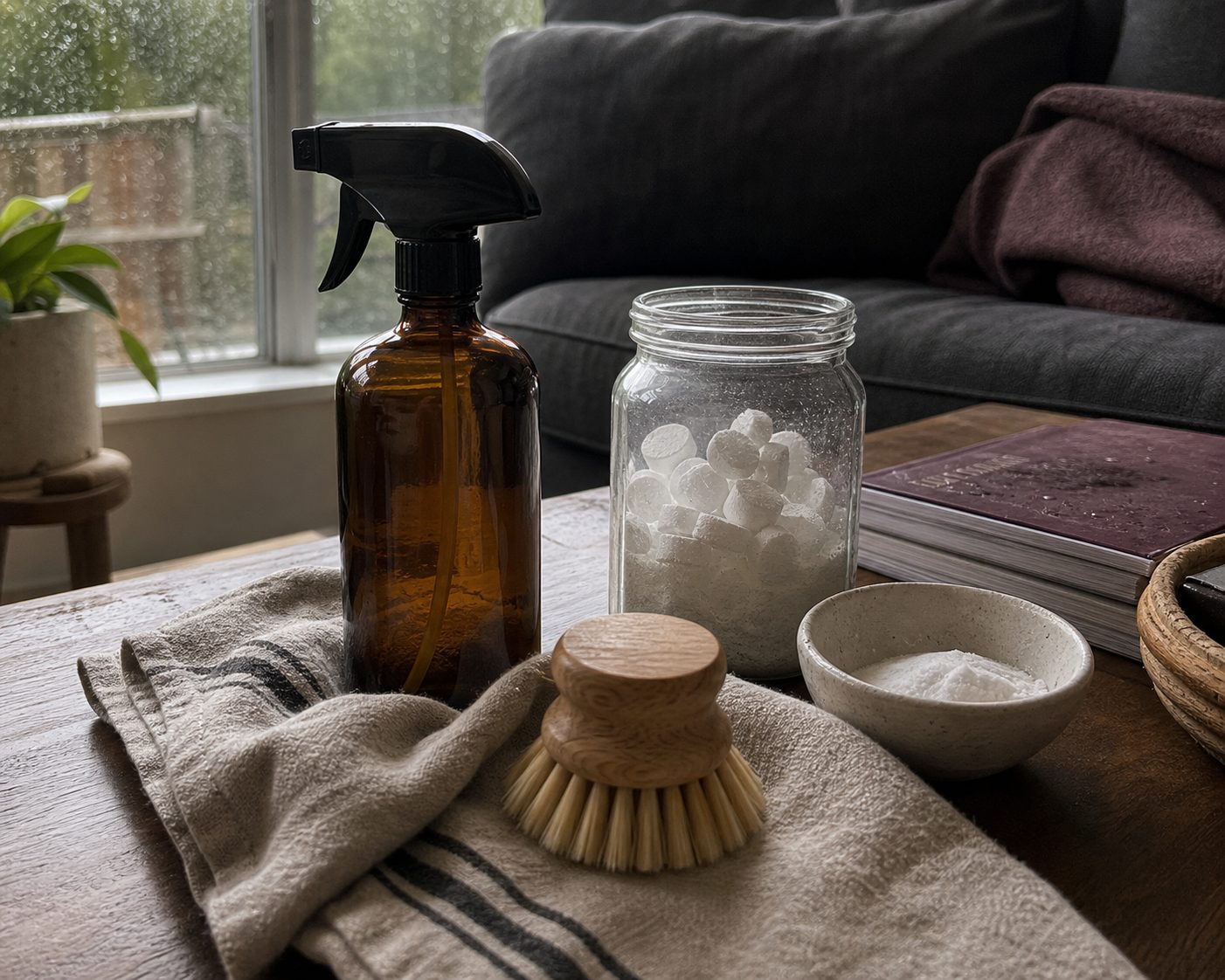
Once you know what is in the bottle, the swaps get easy. For most of what comes up in a normal home, I reach for a few simple things.
- White vinegar and water for glass and hard water spots. Never on natural stone, and never mixed with bleach.
- Baking soda as a gentle scrub for sinks and tubs.
- ECOS Free & Clear dish soap, which is genuinely fragrance-free and dye-free.
- Dr. Bronner's Sal Suds diluted for floors and counters. It is not fragrance-free, but its scent comes from fir needle and spruce essential oils rather than a synthetic fragrance blend, which the company lists right on the label (Dr. Bronner's ingredient list). That is the kind of honesty I am happy to pay for.
If you want the full picture of how I put these together for a whole house, I wrote it all up in my non-toxic cleaning guide for busy homes. This post is the "why" behind that guide.
The takeaway
Conventional cleaners are mostly water and soap, and the soap part is rarely the problem. The trouble is the scent and the mystery behind that one little word on the label. You do not have to be afraid of your cleaning cabinet. You just get to be a little choosier about what you let into the air. Start by reading the back of one bottle this week. That is honestly where it all begins.
This is the approach we bring to every home we clean. If you would rather hand it off, we offer residential and commercial cleaning across Pittsburg, Topeka, and the surrounding area, and we are glad to work fragrance-free. Most of what we do is house cleaning in Pittsburg and the towns around it. Get in touch and we will start with a free walkthrough so you can tell us what you want kept out of your home.