Have you ever walked past a house on a cool evening and caught that warm, sweet laundry smell drifting out of the dryer vent? I always thought it smelled like clean. Like somebody in there was taking care of their people.
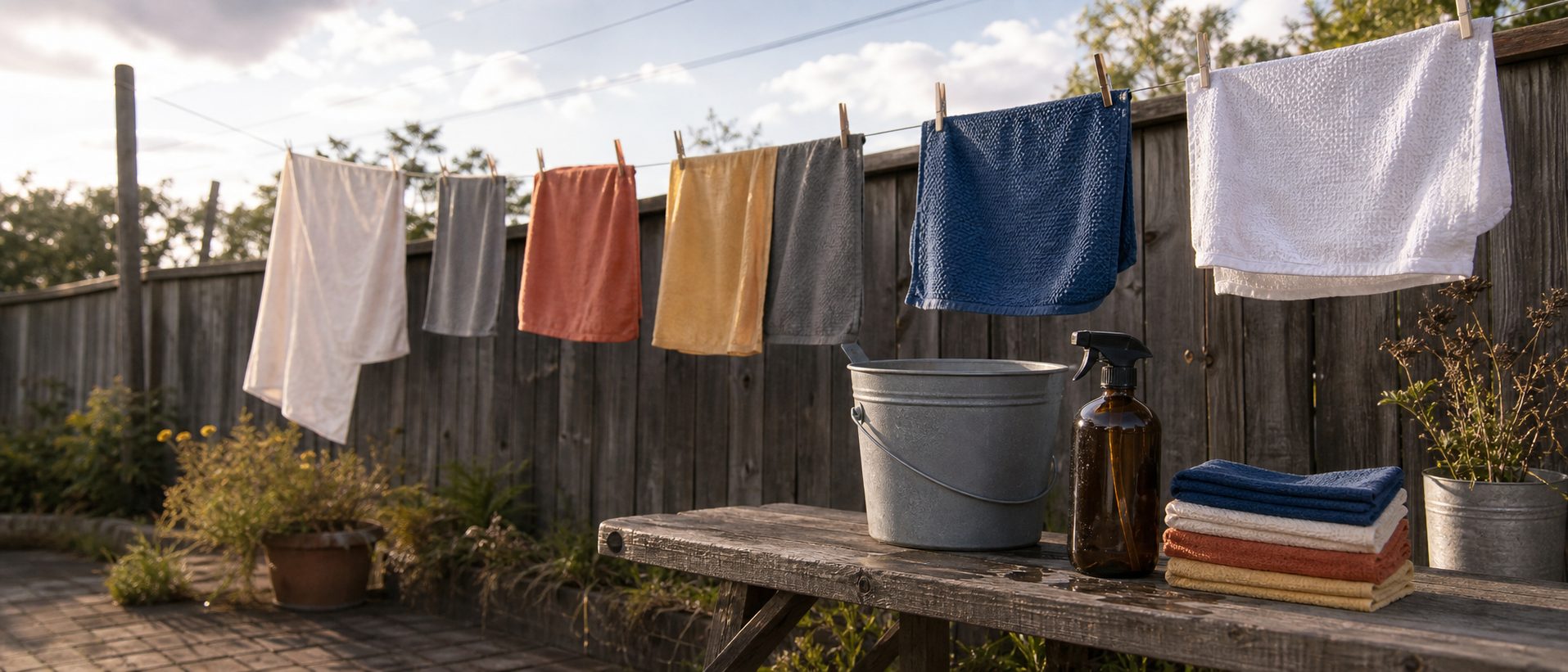
Then I started thinking about it. If I can smell it from the sidewalk, it isn't staying in the towels. It's going somewhere. Same with the plug-in in the hallway that keeps a house smelling like "fresh linen" for six weeks straight. Something is coming out of that thing all day and all night, while your kids sleep down the hall.
So I went and read what researchers actually measured. Not the packaging. The measurements. Here's what I found, including one result that genuinely surprised me, and what we do instead in our house and in our clients' homes.
What actually comes out of a dryer vent
A team led by Anne Steinemann sampled the air coming out of residential dryer vents while normal loads ran with fragranced detergent and fragranced dryer sheets. They found more than 25 different volatile organic compounds coming out of those vents. The ones at the highest concentrations were acetaldehyde, acetone, and ethanol. Seven of the compounds they found are classified as hazardous air pollutants, and two of those, acetaldehyde and benzene, are classified as carcinogenic (Air Quality, Atmosphere & Health, 2013).
I want to be careful here, because this is where a lot of articles go off the rails and start scaring people. That study measured what comes out of a vent. It did not measure what happens inside a person. Those are two different questions, and anyone who tells you the second one is settled is selling you something.
But it does answer the question I actually had, which was pretty simple. Is that smell staying in the laundry? No. It's leaving the vent, and some of what's leaving isn't just "fragrance."
The part that surprised me
This is the one that changed how I think about the whole thing.
Researchers sampled six homes' dryer vents and tracked one compound, D-limonene. It's a citrus-smelling terpene that turns up in a lot of scented laundry products. In the homes using fragranced detergent, the highest reading at the vent was 118 micrograms per cubic meter, and the average was about 33. In homes using only fragrance-free detergent, the highest reading was 0.26, and the average was 0.25.
Then they had the fragranced households switch to fragrance-free and measured again. D-limonene in the vent air dropped by as much as 99.7 percent, with an average drop of about 79 percent (Air Quality, Atmosphere & Health, 2019).
That's the whole intervention. No machine, no filter, no air purifier, no gadget. They changed the bottle.
I'll be honest about the limits, because that matters to me. That's six dryer vents, tracking one compound, in a single study. It's small. But it lines up with the simplest logic there is. If you stop adding the scent, the scent stops coming back out. And it's the rare piece of research where the fix costs about the same as what you're already buying.
What a plug-in is actually doing
A plug-in doesn't clean your air. I think that's the part people don't quite picture. It isn't a filter. It's closer to the opposite of a filter. It's a small heater slowly evaporating scented oil into your hallway, around the clock, whether anybody's home or not.
And there's a wrinkle. Many of those scent ingredients are terpenes, the same family as the D-limonene from the dryer study. Terpenes react with ozone in indoor air, and those reactions create new things that were never in the bottle, including formaldehyde and ultrafine particles (Atmospheric Environment, 2004).
So even a complete ingredient list can't fully tell you what ends up in the room. The chemistry keeps going after the product leaves the bottle.
Again, I'm not trying to scare anybody. How much of that actually happens depends on how much ozone is in your air, how well the room is ventilated, and how big the room is. It isn't one fixed number and I won't pretend it is. A Kansas July with the windows shut and the AC running is not the same as a breezy October day with the house open.
The "green" version is not the loophole
This is the one that gets me fired up, and it's why I don't just tell people to go buy the leafy-looking version.
Researchers tested 134 common consumer products, fragranced and fragrance-free, including ones marketed as green. Across those products they measured 1,538 volatile ingredients coming off, representing 338 different compounds, and 517 of those were classified as potentially hazardous. Then they compared the green fragranced products against the regular fragranced products. They found no significant difference in the most common potentially hazardous compounds (Air Quality, Atmosphere & Health, 2019).
Read that again. The green one and the regular one, same story. Muted colors and a little leaf on the front did not change what came out of the bottle. That's greenwashing in one sentence, and it's exactly why I quit trusting the front of a label years ago.
And here's the kicker from that same study. Of all the volatile ingredients they measured coming off those products, fewer than 4 percent were listed on the label.
Now, I'm the one always saying to judge a product by the ingredient list on the back instead of the marketing on the front. I still believe that. But this is the honest limit of my own rule. On a fragranced product, the back of the label isn't telling you everything either. "Fragrance" is one word standing in for a lot of things.
Which is why "fragrance-free" is the claim I trust most. It isn't a vibe. It's the one claim that's about what is not in there, and you can check it yourself by looking for whether "fragrance" or "parfum" shows up on the list at all.
So, are they worth it?
Here's my honest take, and I'll flag it plainly as my opinion rather than a finding.
I'm not going to tell you a dryer sheet is going to hurt your kids. I don't know that, and the research doesn't say that. What I'd say instead is this. Of everything in your laundry room, the fragrance is the one ingredient whose entire job is to smell. It isn't cleaning anything. It isn't softening anything. It's there so the product feels like it worked.
So when I weigh it, the question isn't "is this proven dangerous." It's "what am I getting in trade?" For me the answer is a smell I don't need, in exchange for a pile of compounds nobody fully listed for me. That trade isn't worth it in my house, with four girls and everything they already leave on the floor.
Your math might come out different, and that's genuinely fine. I just want it to be your call, made with real information, instead of a decision the packaging quietly made for you.
What we do instead
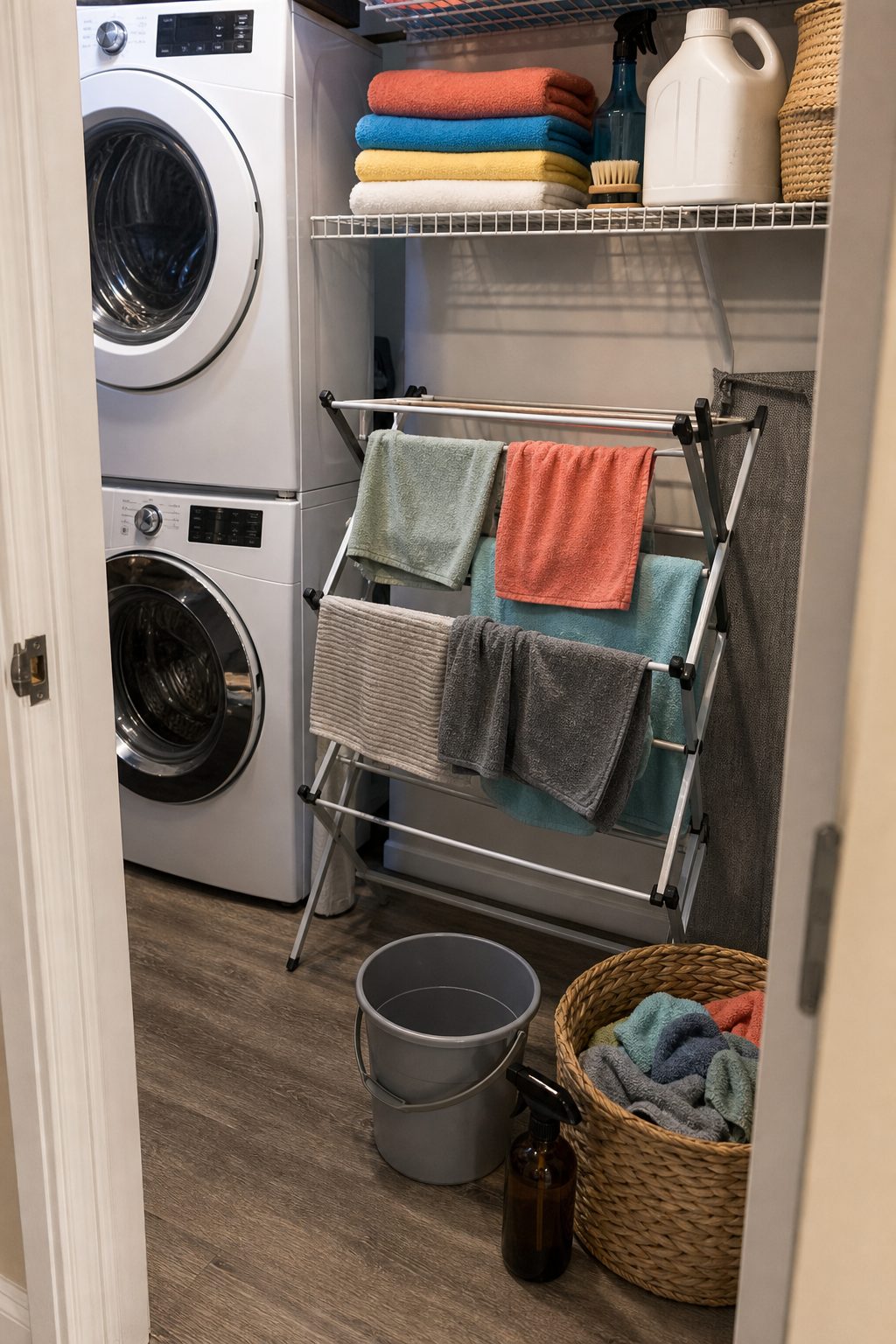
- Wool dryer balls. They knock static down and help a load dry a little quicker in our house. No scent required. If you miss having something, a drop of essential oil on a ball is your call to make, and yes, that's still adding scent. I'd just rather be straight with you about it.
- Fragrance-free detergent. We reach for ECOS Free & Clear, which is free of added dyes and fragrance according to their own ingredient listing. It's a short list, which is the whole point. You can actually read it.
- A splash of white vinegar in the rinse. It helps cut detergent residue and softens things up. Never mix vinegar with bleach. And don't try to run it with castile soap in the same load, because the two just curdle each other into a greasy mess.
- The clothesline, when the weather plays along. Kansas hands us plenty of dry, breezy days. Sun and wind freshen things for free.
- Baking soda in a load that needs help with odor. Cheap, boring, works.
- Open a window instead of plugging one in. Ten minutes of real air moves more than a scented oil ever will.
- Go find the actual source. This is the big one. A plug-in doesn't remove an odor, it just layers over it. If a room keeps smelling, something in it needs cleaned. The trash can itself, not the bag. The disposal. The fridge drawer. The pet bed. The drain. Clean the thing and the smell leaves for real.
That last one is most of our job, honestly. People are sometimes surprised that after we clean, their home doesn't smell like much of anything. It just smells like nothing in particular. That's not us cutting a corner, that's the whole point. We switched all our cleaning solutions to products without synthetic fragrance once we realized some of the "green" ones we'd been buying were greenwashed and still carried harsh ingredients. It's better for your family, better for your pets, and better for the people on my team who handle this stuff every single day.
If you've got kids or pets
A couple of plain thoughts, not scary ones.
Little kids live down low, on the floor, and they breathe faster relative to their size. Pets are down there too, and they're smaller than we are. So the same room isn't quite the same room for them as it is for you. That's not a reason to panic. It's just why I'd rather not run a scented oil twenty-four hours a day, three feet off the ground, in a hallway somebody sleeps next to.
And if anybody in your house deals with asthma or migraines, fragrance is worth pulling out for a few weeks just to see what happens. It costs nothing to test. You'll know pretty quick.
Where I'd start
Don't overhaul everything at once. Just pick the dryer. It's the easiest swap, it's the one with the clearest measurements behind it, and within a week you'll notice your towels still get clean and your house still smells fine. Then, if it feels right, unplug the hallway.
If you want the fuller walkthrough, I put one together in our non-toxic cleaning guide. If you're wondering what's in the bottle to begin with, we broke that down in what's really in conventional cleaners. And if you've heard fragrance compared to secondhand smoke and want to know whether that holds up, I dug into what that claim actually rests on.
If you'd rather just hand it off, that's what we're here for. We clean homes and businesses across Pittsburg and Crawford County fragrance-free by default, no special request needed. You can see everything we do on our services page, and every quote starts with a free walkthrough, so get in touch and we'll come take a look.