Somewhere around the time a baby starts crawling, the floor stops being something you walk across and becomes something they live on all day. I have four girls, so I have been through that stage more than once, and each time it made me look harder at what I was spraying and what I was wiping it up with.
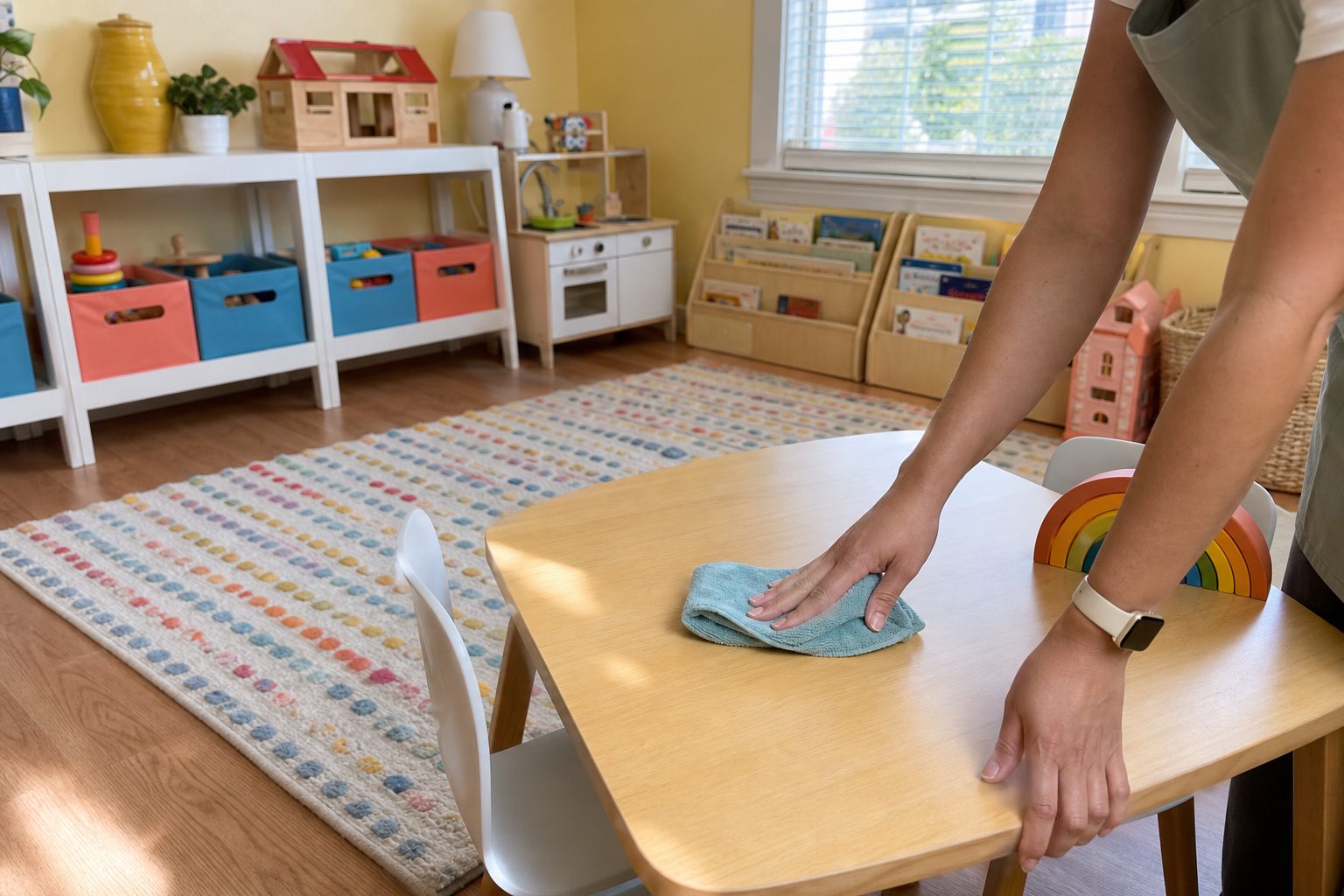
Here is what I check now, what I stopped buying, and what handles the same jobs without leaving a smell sitting in a house where somebody small is always on the ground.
Start with the back of the bottle
The front of a cleaning bottle is written by somebody in marketing. The back is where the information is. Reading labels is the habit that changed my caddy more than any single product did, and it is the first thing I would tell any parent to start doing.
Two things are worth knowing about that list. The word fragrance is a catch-all. It can cover a long list of compounds, and the formula behind it is treated as a trade secret, so the word itself tells you almost nothing about what is in the bottle. The second is that words like natural, green, eco-friendly and plant-based are not held to a standard. A bottle can be wrapped in leaves and kraft paper and still hold roughly what the bottle next to it holds.
That does not make every product with a leaf on it a bad one. It means the front of the bottle is not evidence. Turn it around.
What I stopped bringing home
My list got shorter over the years, and it got shorter for one reason. Almost everything I was buying was doing a job that something simpler already did.
- Anything with added fragrance. This is the big one for me and the reason Green Gorilla switched its whole lineup. Scent is added to a product so it smells like it worked. It does not make the product clean any better, and it is the part that hangs in the air afterward.
- Aerosol cans. Whatever is in them ends up in the air you and a toddler are both breathing, and you cannot rinse the air.
- Disinfectant sprays used as air freshener. A disinfectant is for a surface. Spraying one into a room to fix a smell is using it for something it was not made for.
- Anything sold on the word natural alone. If that is the whole argument on the label, I put it back.
I also stopped buying the same cleaner in four different scents. One bottle that does the job beats four that each do a fraction of it, and it takes up less space under a sink a kid can open.
What I use instead
My caddy is small and it has not changed much in a while. Concentrates do most of the work, partly because I am not paying to ship water and partly because a bottle I refill is a bottle that is not in a landfill.
These are the ones I actually reach for. Dr. Bronner's Sal Suds is a concentrated all-purpose cleaner and it handles the bulk of my general cleaning. ECOS free and clear is a scent-free soap I use for everyday surfaces. Mrs. Meyer's Baking Soda Cream Cleaner is the one in my caddy that does have a scent, so I use it in rooms where the smell will not sit, and I would not call it fragrance-free. Alongside those, the plain staples: white vinegar, baking soda, castile soap, and a stack of microfiber cloths.
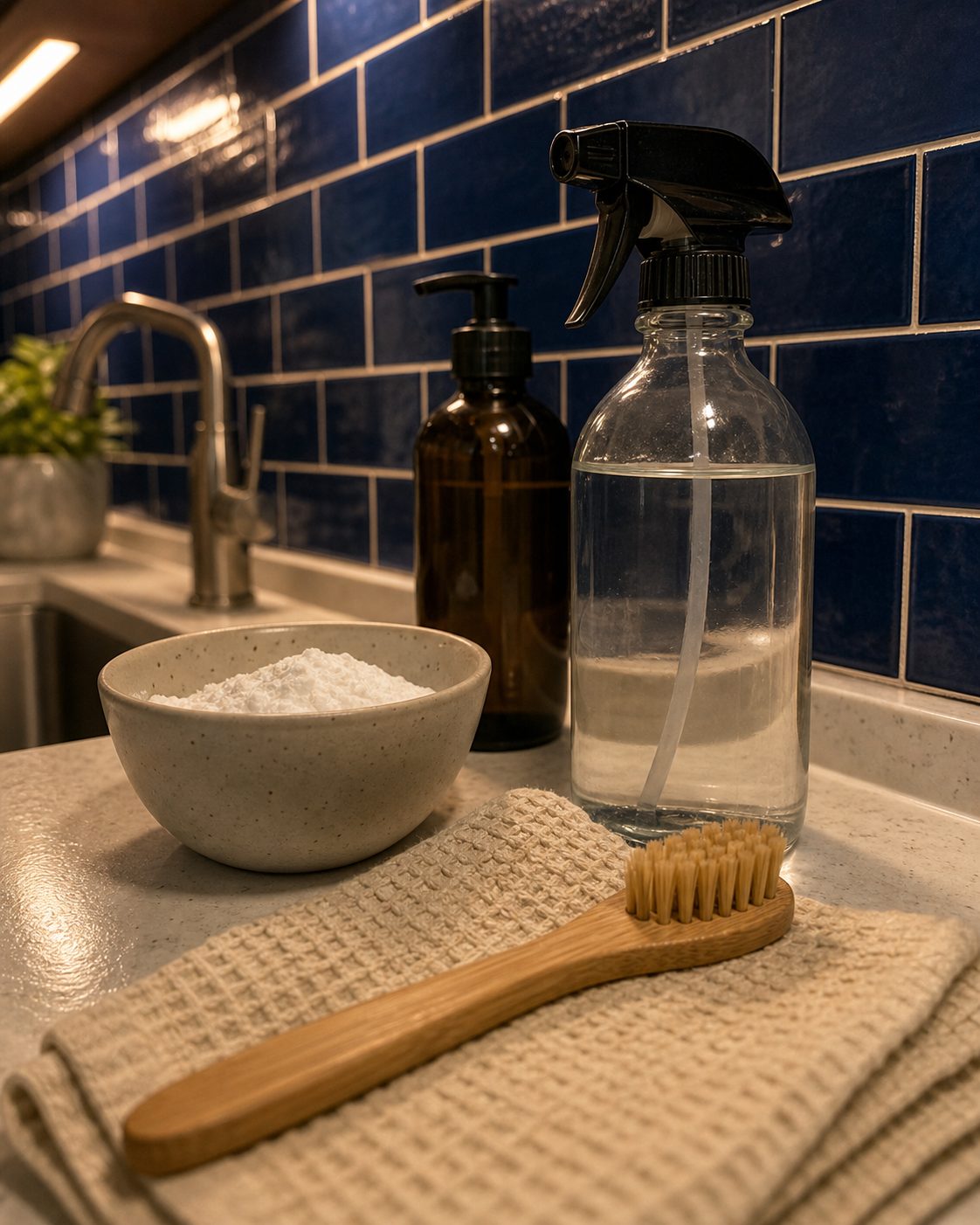
Most of the jobs a specialty product claims to solve are a paste, a soak, or a cloth. An oven, a stovetop and a sink all come clean with baking soda and patience. Hard water on glass and chrome comes off with vinegar if you let it sit. None of that leaves anything behind that I have to worry about later.
Around babies and toddlers
The floor is the surface that matters most in a house with a crawler, and it is the one people think about least. Whatever you mop with leaves a film behind, and if a baby spends the afternoon on that floor with their hands in their mouth, the film goes along with it in small amounts all day.
Three things I do differently now. I rinse. After the cleaner has done its job, I go back over the floor, the high chair tray and the table with a clean damp cloth and plain water. Wiping lifts most of the residue and the rinse takes the rest. Second, cloths get separated. The rag that did the bathroom does not come back to the kitchen. Third, I air the room out while I work instead of after, because a window open during the job does more than a window open once the smell has already settled.
One caution on vinegar, since it shows up in every list like this. It is an acid. On natural stone and some sealed wood it will dull the finish over time, so I keep it to tile, glass, chrome and the floors that can take it, and use plain water or a drop of castile soap on the rest.
Around pets
Pets are harder to plan for than kids, because a cat walks through whatever you just mopped and then sits down and cleans their paws. A dog puts their nose in the corner you just sprayed.
A few things I have landed on. Food and water bowls get washed in the kitchen with soap and hot water rather than wiped with a surface spray, and they get their own cloth. Floors get rinsed the same way I rinse for a baby, because paws and bare feet are on the same surface. Litter boxes get scooped often and cleaned with something simple, and I do not use vinegar as a deodorizer near one, since the smell puts a lot of cats off the box entirely.
If you keep birds or fish, be extra careful with anything that goes into the air. Those are the two where a small amount of the wrong thing in the air matters more than it does for a dog or a cat, so I do not spray anything near them and I do not use aerosols in that room at all.
On essential oils, I am cautious. It is easy to assume a plant-based oil is safe because it smells like a plant, and cats in particular are not good at clearing some of the compounds in them. I use very little, and not around the bowls or the litter box.
The rules I do not bend
Most of what sends people to the internet at eleven at night is a mixing mistake, not a product choice. These are the ones worth taping inside a cabinet door.
- Never mix bleach with ammonia. That combination makes a gas that will clear a house. Ammonia turns up in glass cleaners and in some pet odor products, which is how people run into this without meaning to.
- Never mix bleach with vinegar or any other acid. Same problem, same reason. It includes the vinegar you were about to add to make the bleach work better.
- Never mix bleach with hydrogen peroxide. Two bottles that both look like a good idea together are not.
- One cleaner at a time, in a rinsed bucket. Empty it and rinse it between products instead of topping it up.
- Ventilate while you work. Open a window, run the fan, and take the kids and the pets out of the room.
- Give it the dwell time on the label. A cleaner that needs a few minutes to work does not work faster because you scrubbed harder.
- Store it high, closed, and in the original bottle. Never in a drink bottle, never in a cup, and never within reach of a kid who can climb.
The habits that matter more than the bottle
If you only change one thing after reading this, change how often you rinse rather than which brand you buy. Rinsing is the step most people skip, and it is the step that decides how much cleaner is still sitting on a counter a child eats off later.
The rest is small and boring. Shoes come off at the door, because most of what ends up on a floor walked by a baby got walked in. Surfaces that touch food get a plain water pass. Hands get washed after cleaning, including yours, since your hands are the thing that then touches the baby. And the house gets aired out rather than scented, which is the one habit that made the biggest difference in ours.
Frequently asked questions
Are natural cleaning products safe around kids and pets?
Natural is a marketing word with no safety standard behind it. Nothing on a bottle front is held to a rule that makes it safe for a child or a pet. I read the back and treat natural, green and eco-friendly as claims to check rather than promises to trust.
Is vinegar safe to clean with when you have pets?
Diluted white vinegar is a workhorse in my caddy and I use it on floors, glass and hard water. Two caveats. It is an acid, so it can dull natural stone and some sealed wood, and it should not go near a litter box or food bowls as a deodorizer. Rinse the surface with plain water after.
Can I use essential oils around a cat?
I keep essential oils to a minimum and I do not treat them as automatically safe because they are plant based. Cats in particular are not good at clearing some of the compounds in them. If you want scent in a house with a cat, I would rather you skip it than guess.
Do I need to rinse a surface after I clean it?
On anything a child or a pet touches with their mouth, yes. Counters, high chair trays, tables and floors all get a pass with a clean damp cloth and plain water after the cleaner has done its job.
Is bleach ever okay in a house with kids?
Yes, used carefully and by itself. The danger is mixing. Bleach with ammonia makes a gas you do not want in a house, and bleach with vinegar or any other acid does the same. Use it in a ventilated room, never in a bucket that has held another cleaner, and never in a spray bottle you also use for something else.
Does fragrance-free mean there is nothing in it?
No. Fragrance-free means no scent has been added. The rest of the formula is still a formula, so it is worth reading the whole list. What it does mean is that you are avoiding the catch-all word fragrance, which on a label can stand in for a long list of compounds.
Where to start
Pick one swap, not five. The fragrance is the one I would start with, because it is the easiest to spot on a label and the one you will notice in the air the same day. If you would rather not think about any of it, that is what my non-toxic cleaning guide is for, and there is a longer look at what is really in conventional cleaners if you want the why behind it.
If you would rather hand the whole thing off, that is what we do. Green Gorilla cleans homes and businesses across Pittsburg and the surrounding Crawford County towns with fragrance-free products, and every quote starts with a free walkthrough. You can read more about our house cleaning and other services, or get in touch.