A cleaning chart with twenty-four little boxes is a nice thing to make and a miserable thing to live with. I have made several. I have also abandoned every one of them by the second week.
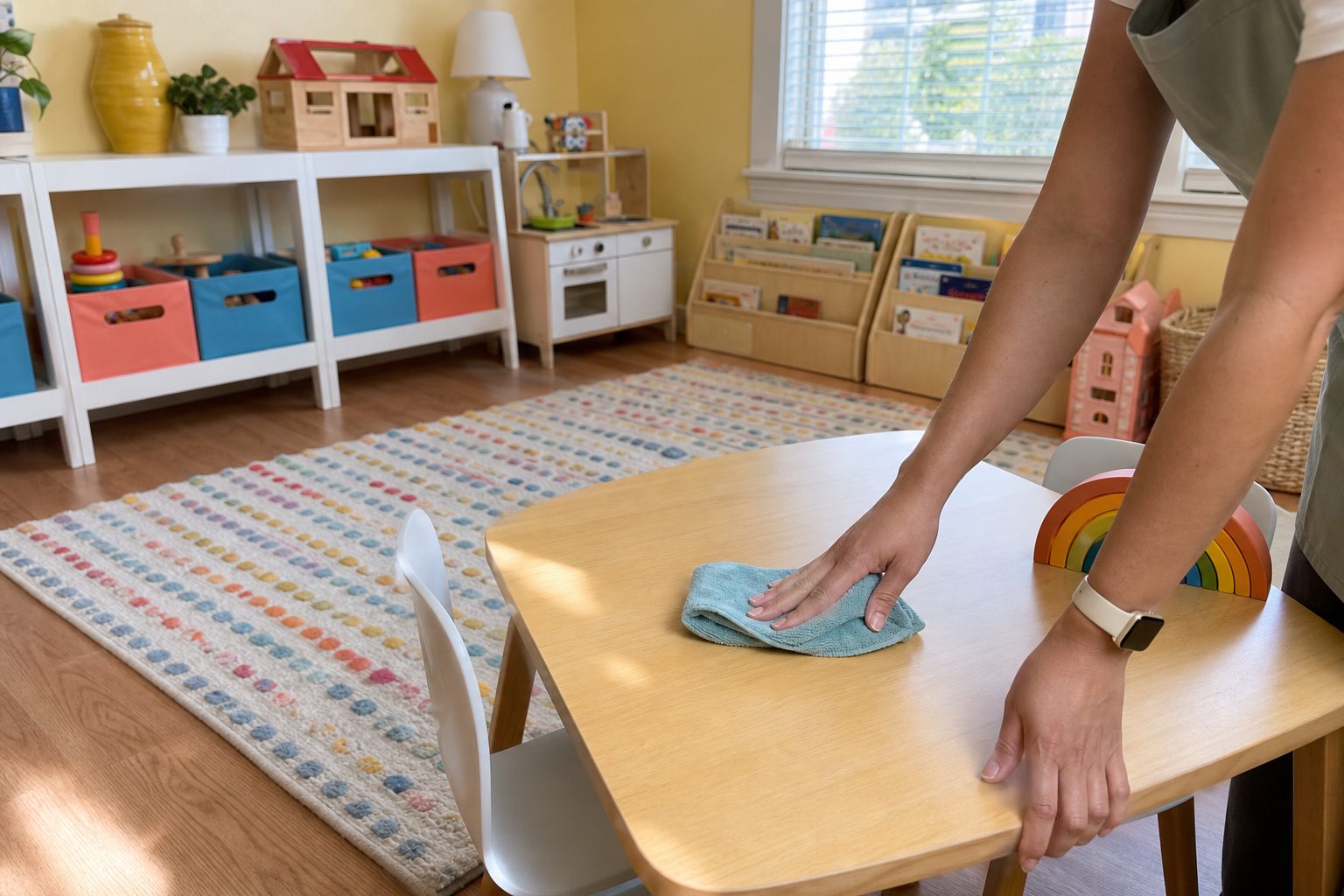
I have four girls, and I run a cleaning company, and our house is still not spotless. What I have figured out is that a routine only survives if it fits inside the week you actually have. That is a week with maybe fifteen spare minutes in it. The routine has to fit inside those minutes or it does not happen at all.
So this is the version that stuck. It is what we do in our house, and it is close to how we work through the homes we clean around Pittsburg.
Lower the bar before you do anything else
If your idea of a clean house is the one in the photos, no routine will ever be enough and you will quit in two weeks. I would rather you aimed at something you can actually hit.
Clean enough, in a house with kids and pets, means a few specific things. Floors are clear of crumbs. Kitchen counters get wiped. The bathroom is not a science experiment. Beds get made, badly, by the person who sleeps in them. Everything else can slide, and it will slide on the weeks when someone has a fever.
That is not me lowering the standard to be nice. It is the standard that keeps a house healthy and keeps you from burning out on it.
The fifteen minutes that do the most
The single change that helped us most was shrinking the job down. A clean house is a handful of small loops, run often, rather than one big project you have to find time for.
After dinner, before anyone disappears:
- Counters and the stovetop get wiped. This one takes about three minutes and it is the reason our kitchen never turns into a disaster.
- Dishes get loaded, or at least stacked and soaking. Nobody wants to meet last night's pan in the morning.
- One load of laundry starts. Fold it tonight if you have the energy, and leave it for tomorrow if you do not. What matters is that it keeps moving.
- Everyone picks up their own things for ten minutes. Set a timer if you have to. Timers turn this into a game instead of a fight.
That is it. None of it is impressive and all of it compounds.
Mornings get one job too, and only one: unload the dishwasher while the coffee brews. If you wake up to an empty dishwasher, the whole day's dishes have somewhere to go.
What the week looks like
Spread the bigger jobs out so no single day swallows your evening. Ours lands roughly like this.
- Monday is bathrooms. Sink, toilet, mirror, and a quick wipe of the floor.
- Tuesday is bedrooms and dusting. Change the sheets on the beds that get slept in hardest.
- Wednesday is floors. Vacuum the traffic paths, mop the kitchen and the bathroom.
- Thursday is the catch-all. Whatever got skipped, plus the entryway, which is where every leaf and every wrapper in Crawford County ends up.
- Friday is the kitchen, a little deeper than the nightly wipe.
- Saturday is laundry and linens, and only if the week left you the energy for it.
If you only get two of those done, do Wednesday and Monday. Floors and bathrooms are what guests actually notice, and they are also the two that matter most for a house with kids in it.
And if the week keeps beating you anyway, that is usually a sign the house needs one reset more than it needs a tighter schedule. We can do that reset for you, and then the routine has somewhere to start from.
I want to be honest about the seasonal part, because this is Kansas. From spring into early summer the pollen here is relentless, and dust that sits on a shelf in February turns into a film by May. I dust more in April and May than I do in December, and I leave the windows closed on the high-pollen days.
What you clean with matters more than how often
Here is the part almost every cleaning schedule online skips, and it is the part I care about most.
The research on household cleaning products and kids is not reassuring. A Canadian birth cohort study followed just over two thousand children and found that higher use of cleaning products in early infancy was associated with higher odds of an asthma diagnosis by age three. The products most strongly flagged were the ones that put scent or droplets into the air: spray air fresheners, plug-in deodorizers, and dusting sprays (Parks et al., CMAJ, 2020).
An earlier study measured lung function in school-age children and found that air freshening sprays were associated with lower lung function and higher markers of airway inflammation (Casas et al., European Respiratory Journal, 2013).
A separate body of work looked at what fragrance actually emits. One study tested 37 common fragranced products, including cleaners and air fresheners, and found 156 different volatile organic compounds coming off them, 42 of them classified as toxic or hazardous under federal law. The finding that should bother you most: the products labelled green or organic gave off about the same hazardous compounds as the regular ones (Steinemann, Air Quality, Atmosphere & Health, 2016).
I want to be careful here, because the finding is narrower than it can sound. The category these studies keep pointing at is the product that puts scent or droplets into the air. That is a smaller claim than cleaning being bad for you, and it is the one the evidence actually supports.
So in our house, and on our crews, the rule is simple. We clean with fragrance-free products, and we do not use anything that puts a scent into the air to prove the room got cleaned. A room that smells like nothing is a room where the mess is gone and nothing was added back on top of it.
You do not need a cabinet full of specialty bottles either. White vinegar, baking soda, castile soap, and a stack of microfiber cloths will handle most of a house. I wrote up the fragrance-free guide if you want the longer version, and I have a whole post on why dryer sheets and plug-in air fresheners are the two easiest things to drop first.
Let the kids carry some of it
You are not the only person who lives there, and a routine that assumes you are will not hold.
Match the job to the age and expect it to be done badly for a while. Toddlers can put toys in a bin and carry their own plate to the sink. Elementary-age kids can make a bed, set a table, and wipe their own spot. Older kids can vacuum a room, empty the dishwasher, and run a whole load of laundry start to finish.
The help is the smaller half of it. A ten-year-old who knows how the washing machine works is a ten-year-old who will not bring you a basket of wet towels at midnight in four years. A few badly folded shirts are a fair trade for that.
Once a month, and once a season
Monthly jobs are the ones that make a house feel cared for rather than just tidy. Baseboards, the inside of the microwave, the front of the cabinets, the fridge shelves, and the vent over the stove. Put them on the same day as something you already do, so they actually happen. Ours is the first Saturday.
Seasonally, we do the swap. Screens come off and get hosed down, the ceiling fans get dusted before they run all summer, and the storm windows get checked before the first cold snap. In a town with as many older houses as Pittsburg has, that round is worth more than any deep clean you do in the middle of July.
If the whole house has gone past the point where a weekly loop will bring it back, that is a different job. That one is what a deep clean actually adds, and it is easier to start a routine from a clean house than from a losing one.
When to hand it off
Some seasons do not fit a routine at all. A new baby, a move, a stretch of overtime, or a house that needs to be ready for guests on short notice. Hiring help for those weeks is exactly what a system is for.
We do residential cleaning in Pittsburg and across the Crawford County towns we serve, including Frontenac, Girard, Arma, Franklin, and Cherokee. Every quote starts with a free walkthrough so we can see the house and you can tell us what matters to you. Call us at 620-408-3841 if you would rather just talk it through.
Frequently asked questions
How often should you actually clean your house?
The floors and the bathrooms want attention every week. Bedrooms and dusting can go every week or every other week without much harm. Baseboards, vents, and the inside of appliances can wait for a monthly round. Pick the weekly list you will genuinely finish, and let the rest run on a longer cycle.
Is a daily cleaning routine worth it if you only have ten minutes?
Yes. Ten minutes a day beats three hours on Saturday, because the mess never gets far enough ahead of you to feel hopeless. Wipe the counters, run the dishes, start one load of laundry, and have everyone pick up their own things.
How do you keep a house clean with kids and pets?
Lower the standard to something you can hit, give the kids real jobs matched to their age, and choose products that do not leave fragrance in the air. Kids and pets are also the reason to skip the spray air fresheners and plug-in deodorizers entirely.
What products do you use?
Fragrance-free ones, chosen by reading the ingredient list on the back rather than the front of the bottle. Concentrated products where we can, because they mean far less plastic. Staples like white vinegar, baking soda, castile soap, and microfiber cloths cover most of what a house needs.
Do you have to clean every day to keep up?
No. Two short loops, one in the morning and one after dinner, plus one bigger task on most weekdays, is enough to keep a normal house in good shape. If you miss a day, nothing terrible happens. Pick it back up the next one.
What is the difference between a standard clean and a deep clean?
A standard clean maintains a house that is already in decent shape. A deep clean goes after what a routine does not reach: baseboards, vents, the inside of the oven and fridge, grout, and the build-up behind furniture. You run a deep clean once to get the house back to zero, then let the routine hold it there.
Do you serve towns outside Pittsburg?
Yes. We serve Pittsburg and the surrounding Crawford County communities, including Frontenac, Girard, Arma, Franklin, Cherokee, and Mulberry. The full list is on our areas we serve page.
Start with tonight
Skip the chart. Tonight, wipe the counters, start one load of laundry, and have everyone put their own things away for ten minutes. Do that four nights in a row and you will have most of what a cleaning routine is actually made of.
If you want help getting the house back to a place where a routine can hold, Green Gorilla cleans homes across Pittsburg and Crawford County, KS, with fragrance-free products and a free walkthrough before any quote. Call 620-408-3841 or get a quote.